
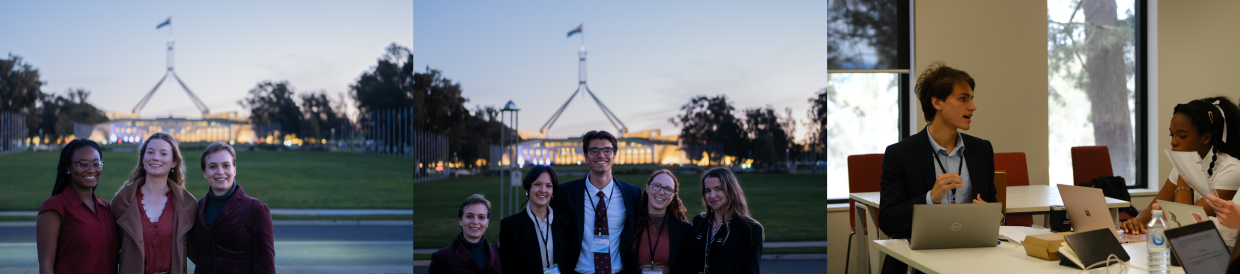
Last month, I was honoured to be one of 50 students from across Australia selected to attend the Australian Crisis Simulation Summit (ACSS), alongside fellow Liveris Academy scholars Arwen Keith, Saul Nicol-Rann and Anneliese Whitbread. This four-day event held at the Australian National University in Canberra brought together students from a range of backgrounds to connect with industry leaders, learn about national security pathways, and experience dealing with a crisis in two full days of hands-on, hectic and intricately connected crisis simulations.

Here’s three of my key takeaways from the program:
1 It is important to know how to disconnect from a problem.
Every few hours at the ACSS the news feeds switched off, the crisis paused, and we all gathered for a meal break in the common area. Our industry mentors encouraged us, often quite firmly, to not think about the program during breaks and allow our brains to reset.
In a real crisis, there is no finish line. The ability to switch off, head home and rest even as a crisis is unfolding is essential. There is no use working all night if no-one can keep going the next day. At the ACSS I gained a profound respect for those who operate successfully under this level of pressure, and a desire to build the skills so I can do the same.
2 Communication isn’t optional.
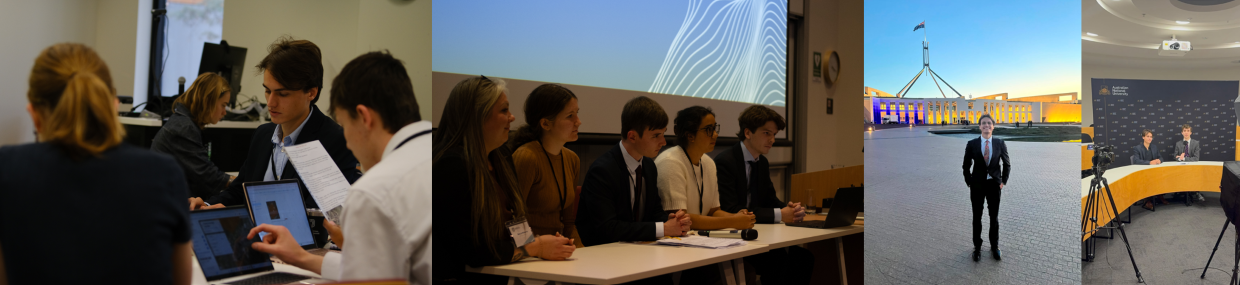
Communication is more than networking (which we were able to practice at Old Parliament on the second night). It is more than responding to media interrogation - or in this case, the ACSS executive team, armed with a camera and a live stream to all rooms. In a crisis, effective communication between sectors is the difference between success and failure.
The crisis simulation involved ten teams split across different governmental departments. Information was dispersed unevenly, often with varying classification levels. When we worked as the Australian Signals Directorate, it was tempting to only share intelligence with teams at the same classification level, but it quickly became clear that information needed to be declassified and distributed to allow all groups to achieve their objectives. Without collaboration and clear communication channels, progress cannot be made on a problem.
3 There isn’t always a correct answer.
As an undergraduate mathematics student, most of the problems I focus on are solvable. With enough time, energy and creative ideas, there’s an answer waiting, usually derived directly from the course notes. Proofs aren’t left unfinished.
But in the ACSS simulations, the briefs we were asked to produce, often under tight deadlines, were not always able to be completed. When working as the Treasury, our team motto quickly became “we are monitoring the situation”. Admitting what you don’t know is a skill in itself. The real world doesn’t have a marking guide. Instead, we must operate under incomplete situations.
A vote of thanks
Thank you to the ACSS executive team – the tireless work they have done over the last twelve months shone through in every aspect of this year’s program and is very much appreciated! I highly recommend this event next year to any Australian university students, regardless of your background.
Thank you to my team, Nick Charvell, Evan Hunt, Amari Leiva-Urzua and Rebecca R, and our mentor Tara Shaw – we worked so well together!
And finally, a massive thank you to the Liveris Academy for supporting Arwen Keith, Saul Nicol-Rann, Anneliese Whitbread and I to attend this fantastic event. It is opportunities like these which reinforce the value of developing skills across a breadth of disciplines, something the Liveris Academy champions.


